Task-Based Roles vs Position-Based Roles in SAP: Moving Beyond Role Stacking
Traditional SAP role architectures rely heavily on task-based bundles and shared composite roles, driving severe authorisation creep and inflated licence tiers. Shifting to position-based role design decouples what users can do from what they actually do, securing your landscape while driving smart cost reductions.
The hidden trap of task-based role construction
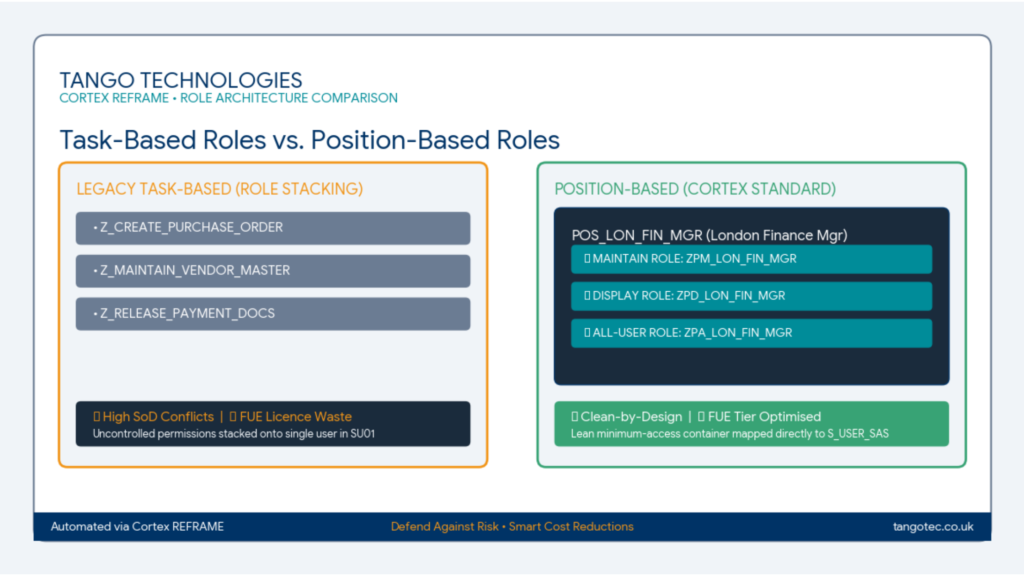
For decades, SAP security teams built roles by bundling specific tasks (e.g., “Create Purchase Orders” or “Maintain Vendors”) into standalone, ad-hoc roles. When an employee needed access, administrators simply stacked these task roles onto the user’s profile in transaction SU01.
Over time, this “role stacking” creates severe operational and commercial liabilities:
- Rampant Segregation of Duties (SoD) Violations: Stacking independent task roles on a single user frequently creates toxic combinations, such as vendor creation paired with payment release, that pass unflagged until external audit day.
- Uncontrolled Licence Bloat: Under the SAP RISE and S/4HANA Full Usage Equivalent (FUE) model, assigning a task role containing a single unmonitored “Advanced” transaction code (like ME21N or FB60) instantly escalates an employee from a 0.2 FUE (Core) tier to a 1.0 FUE (Advanced) tier, even if that transaction is never executed.
- Painful On-boarding and Off-boarding: With no clear mapping between SAP access and business job descriptions, IT teams rely on “copying previous users,” compounding historical security errors across generations of employees.
Comparing core governance metrics
- Design Methodology: Legacy task-based roles rely on subjective interviews and text-heavy assumptions. Position-based roles use empirical system activity data (ST03N) and statistical similarity clustering to build factual role blueprints.
- Role Structure: Task-based architectures generate fragmented, overlapping task shells. Position-based frameworks deploy a single Composite Role container (
ZPC_LON_FIN_MGR) wrapping dedicated Read (ZPS_LON_FIN_MGR_R), Update (ZPS_LON_FIN_MGR_U), and Global All-User (ZPS_GBL_GEN_ALL_USER) single roles. - Licence Cost Impact: Task-based roles trigger unchecked FUE escalation. Position-based design enforces a minimum-access footprint mapped to the lowest legitimate FUE tier.
- SoD Risk Profile: Task-based stacking creates high risk for toxic combination drift. Position-based roles are clean-by-design with pre-emptive risk checks built directly into the blueprint phase.
- Testing Disruption: Task-based testing forces key users into manual, disruptive UAT in test clients. Position-based validation uses live background shadow tracing (STUSERTRACE) with zero user downtime.
- Audit Compliance: Task-based models leave behind opaque, defenseless roles. Position-based architecture produces fully traceable, documented, and audit-ready profiles backed by usage evidence.
The Tango Standard: Precision through Position-Based Architecture
The Importance of Understanding Task-Based Roles
Position-based role design eliminates role stacking by tailoring access to tightly defined user cohorts who perform identical business functions. Every position receives an intentionally architected Composite Role (e.g., ZPC_LON_FIN_MGR) that acts as a container holding dedicated single roles: a Read Single Role (ZPS_LON_FIN_MGR_R), an Update Single Role (ZPS_LON_FIN_MGR_U), and a Global All-User Single Role (ZPS_GBL_GEN_ALL_USER).
Building position-based roles manually used to require months of disruptive business interviews. Today, Tango Technologies automates this entire lifecycle through the Cortex Suite:
- Statistical Similarity Clustering (Cortex REFRAME): Reframe imports multi-year historical execution logs and groups users into “Similarity Clusters” based on identical real-world working patterns, automatically generating lean, position-based role blueprints.
- Clean-by-Design SoD Protection (Cortex INSIGHT): Before a position-based blueprint is generated in PFCG, Insight simulates proposed transaction combinations against your ruleset, flagging toxic combinations before live deployment.
- Zero-Disruption Shadow Simulations (Cortex REFRAME): Reframe runs background shadow simulations using provisioned Reference Users (
STUSERTRACE), tracing access patterns in live runtime environments and automatically injecting missingSU24authorisation objects back into the Read (ZPS_..._R) and Update (ZPS_..._U) single roles while end-users work uninterrupted. - Licence-Aware Access Governance (Cortex ECHO): Position-based roles are calibrated against commercial impact. Echo evaluates transaction inheritances within each position blueprint, ensuring junior operational roles do not contain dormant permissions that trigger expensive 1.0 FUE “Advanced” classifications.
- Empirical Audit Proof (Cortex VAULT): Vault continuously compresses and stores runtime statistics into a searchable memory bank, providing external auditors with definitive mathematical proof of actual transaction execution versus assigned potential.
Designing for long-term system stability
Transitioning from chaotic task bundles to structured position-based roles isn’t just a technical cleanup, it is a strategic commercial decision. By grounding role design in factual system activity data and automating deployment through Cortex REFRAME, enterprises eliminate SoD conflicts, accelerate S/4HANA migration timelines, and secure immediate, lasting licence cost reductions.
Frequently Asked Questions (FAQ)
What is the difference between a task-based role and a position-based role in SAP?
A task-based role contains permissions for a single discrete action (e.g., approving purchase orders) and requires administrators to stack multiple roles onto a user. A position-based role is an all-inclusive, minimum-access container designed specifically for a single job function, granting all required Read, Maintain, and organisational access in one structured composite role.
Understanding Task-Based Roles in Modern SAP Environments
How do position-based roles reduce SAP S/4HANA RISE FUE licence costs?
SAP classifies user FUE tiers based on potential assigned access, not usage frequency. Position-based roles use system activity data (ST03N) to strip away dormant, high-tier transactions (ME21N, FB60), ensuring users are assigned only the permissions necessary for their specific job, dropping their classification to 0.2 Core or 0.033 Self-Service FUE tiers.
Can legacy SAP GRC rulesets be used during position-based role redesign?
Yes. Cortex INSIGHT natively imports export file formats from legacy SAP GRC tools, allowing you to maintain existing rule configurations while performing pre-emptive access simulations before physical provisioning in SU01.