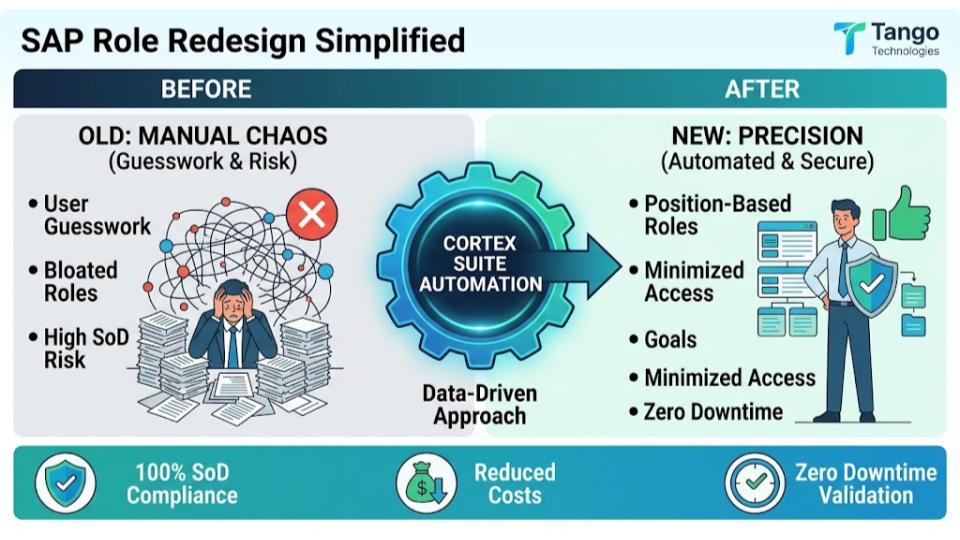
Legacy SAP role redesign projects fail when they rely on subjective user interviews and manual PFCG builds that compound SAP security risks over time. By pairing 30 years of enterprise security expertise with the automated Cortex Suite, Tango Technologies replaces guesswork with empirical execution data to execute a modern SAP role redesign. Our data-driven methodology eliminates SoD compliance conflicts and minimises SAP RISE FUE licence exposure—driving smart cost reductions, defending against risk, and enhancing governance to deliver rapid, fully compliant audit results.
The hidden failure points of traditional SAP role projects
Most SAP role redesigns are triggered by external audit findings, corporate restructures, or upcoming S/4HANA cloud migrations. Yet, traditional consultancies repeat the same disruptive mistakes:
- Subjective Access Requests: Asking users what access they think they need results in bloated, over-privileged roles that trigger severe Segregation of Duties (SoD) conflicts.
- Manual Role Construction: Building roles line-by-line in PFCG is slow, expensive, and almost guarantees inconsistent authorisation logic.
- Disruptive Testing Cycles: Forcing key business users into manual UAT in outdated test clients creates project fatigue and potentially leaves critical processes unvalidated.
- Uncontrolled Licence Bloat: Assigning unmonitored “Advanced” transactions (ME11, FB60) escalates user classifications under SAP RISE Full Usage Equivalent (FUE) models, inflating annual subscription costs.
The Tango Precision Standard: Empirical, Position-Based Security
Tango Technologies re-engineers role redesign into a data-driven, non-disruptive science. Instead of stacking ad-hoc task roles onto user profiles in SU01, we deploy structured Position-Based Composite Containers.
Under this architecture, each business position receives a single governed Composite Role (e.g., ZPC_LON_FIN_MGR). Inside that composite envelope, permissions are strictly segregated into dedicated single roles:
- ZPS_LON_FIN_MGR_R (Read Single Role): Houses all departmental display and read-only permissions.
- ZPS_LON_FIN_MGR_U (Update Single Role): Houses all departmental creation, maintain, and processing permissions.
- ZPS_GBL_GEN_ALL_USER (Global All-User Role): Contains baseline enterprise-wide access, designated as global (GBL) and general (GEN) rather than department-specific.
Uniting the Cortex Suite for Complete Landscape Governance
Manual execution cannot maintain modern SAP security. Tango Technologies embeds our methodology directly into the Cortex Suite, delivering an automated, end-to-end security architecture:
- Cortex REFRAME (Role Design & Maintenance): Evaluates historical execution logs (ST03N) to group users into “Similarity Clusters” based on real working patterns. REFRAME automatically generates position-based blueprints and features prebuilt S/4HANA migration intelligence to map obsolete ECC transactions directly to modern Fiori tiles.
- Cortex ECHO (SAP Licence Optimisation): Evaluates transaction inheritances within proposed role blueprints using a High-Watermark engine. ECHO ensures operational roles do not contain dormant permissions that trigger expensive FUE classifications, while actively monitoring third-party Digital Access document creation.
- Cortex INSIGHT (Visual GRC & Risk Mitigation): Sits in front of your existing GRC setup to perform pre-emptive access simulations before roles are physically built. It transforms opaque database logs into a graphical Risk Command Centre, enforcing time-bound compensating controls to prevent permanent audit blind spots.
- Cortex VAULT (Intelligence & Execution Analytics): Captures, compresses, and stores massive volumes of execution logs ready for deep analysis at anytime. VAULT provides external auditors with definitive proof of actual transaction execution versus assigned potential.
Zero-Disruption Live Validation
Traditional role testing stops daily business operations. Cortex REFRAME eliminates user testing downtime by executing background “shadow simulations” using provisioned Reference Users (STUSERTRACE).
While your employees continue their daily work uninterrupted in production, REFRAME traces execution patterns in the background, automatically capturing and injecting missing authorisation objects back into the blueprint. This proves that new security profiles are 100% safe for production deployment without pulling staff into UAT workshops.
Proven Strategic Outcomes
Adopting Tango’s data-driven methodology delivers immediate, measurable value across technical and commercial operations:
- 100% SoD Audit Compliance: Pre-emptive simulations prevent toxic combinations from ever reaching live production whilst Mitigation allows coverage for those that need to remain..
- RISE FUE Cost Reduction: Minimum-access role design strips away dormant high-tier permissions to drop users to their lowest legitimate licence tier.
- Zero Operational Downtime: Shadow simulations validate roles using background execution logs while staff work normally.
- Audit-Ready Documentation: Every position blueprint is backed by historical execution evidence and immutable change logs.
Whether preparing for an S/4HANA migration, resolving complex audit findings, or eliminating licence waste, the strategy remains simple: Start with clean data, automate with precision, and design for long-term stability.
Frequently Asked Questions (FAQ)
Does Cortex replace our existing SAP GRC platform?
No. Cortex is designed to sit in front of your legacy SAP GRC investment to automate the heavy lifting. Cortex INSIGHT natively ingests existing GRC ruleset export files and performs pre-emptive risk simulations before roles are generated, stopping toxic access combinations from ever reaching SU01.
How does position-based role redesign reduce SAP RISE FUE licence costs?
SAP classifies FUE licence tiers based on potential assigned access rather than usage frequency. By analyzing system activity data, Cortex REFRAME and ECHO strip away dormant, high-tier transaction codes, ensuring users are assigned only the permissions required for their job, dropping their classification.
Why doesn’t zero-disruption shadow testing require business user UAT?
Cortex REFRAME provisions background Reference Users (STUSERTRACE) that mirror active user working patterns. As staff perform their daily tasks, the engine traces access checks in live runtime environments, automatically identifying and resolving missing objects or value without requiring manual test scripts or UAT workshops.